-->
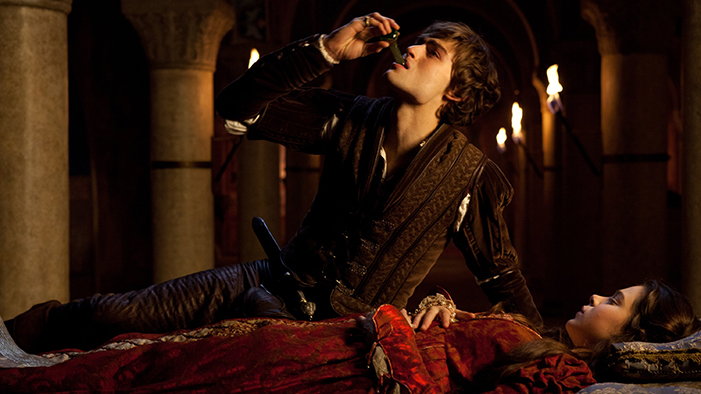
ILL FATED LOVE
“Romeo and Juliet” is a play revered and loved
generation after generation. It’s famous
not for its tragic ending but rather for it’s the dramatic realism. Crafted by
William Shakespeare, it reflects the cruel twisted fate of two tragic lovers.
These “Star Crossed lovers” have inspired many profound musicians, composers, and
directors across the world and thus this inspirational play gave birth to many
marvellous creations of art such as music, play, movie, and symphony. In 1968,
Franco Zeffirelli transformed this theatrical masterpiece into a remarkable
movie and even today the audience is moved by a movie filmed almost seven
decades ago.
Even though Zeffirelli’s movie has its own flaws, it is
noticable that he tried his best to portray the main ideas of the play even
after cutting out one-third of the actual dialogue from the movie's script.
Although he did an amazing work presenting Romeo and Juliet on the big screen,
it must be mentioned that scenes pertaining to Act II Scene II, Act III Scene
I, Act III Scene III and Act III Scene V did have some shortcomings as these
scenes fail to recreate romantic sceneries of the play as well as leaving out
many foreshadowing elements which pointed to melancholic ending of the lovers. While
minimizing dialogs from the movie, he eliminated the conversation between Friar
Lawrence and Romeo after Tybalt’s death which portrays Romeo’s
passionate, devoted love towards Juliet. Its must also be pointed out that
Zeffirelli could have created gems of literary and suspenseful content from the argument scene between Juliet, Lady Capulet,
and Capulet. He could have easily done so by adding layers of deep and slow
music to the scene to truly bring out the cruel essence of the scene. The
mystery behind this star-crossed lover is still charismatic because more it
draws our attention more we feel attached to it. This miraculous play is so
inspirational that different composers, musicians and directors created and
shaped their own interpretation of “Romeo and Juliet” by emphasizing different
events beside the love scenes between Romeo and Juliet. When artists compose a
dramatic symphony or direct a movie based on “Romeo and Juliet,” they do not
present every scene to display the depth of the actual text. Rather the
feelings expressed by works of art by variety of artist depend on the outcome
they desired from their work which is why some composers expressed the intimate
love between Romeo and Juliet in their symphony, some composers expressed the
anger between the two noble families, some composers expressed the sword fight,
or some composers expressed the whole story through the music.
In Zeffirelli’s version both actors were able to
express the famous balcony scene very passionately through their acting but the
only thing that was missing during their profession of love was the music.
Zeffirelli could have superimposed the theme song of the movie while the lovers
were exchanging their love vows and promises. (Theme song of Romeo and Juliet
in Zeffirelli's movie by Nino Rota)
“ What is a youth? Impetuous fire.
What is a maid? Ice and desire.
The world wags on,
a rose will bloom....
It then will fade:
so does a youth,”
Without the
music, the balcony scene lost it’s dramatic love, passion and sentiment. The
melodic sound of the music could have made the audience feel the charm of this
dazzling confession engulfed by the mysteries of the night. The scene was
capable of reaching such a peak, touching hearts but the absence of the music
doesn’t allow the scene to flourish in “true lovable passion.”
The mood in the Zeffirelli’s version is not as tense
as it is in the play. The play builds up the tension as it approached
Mercutio’s death but Zeffirelli could have illustrated it much better by having
much heavier sound of tremble effects to evoke tension in our mind. In this
scene Mercutio and Tybalt express their bitterness towards each other. Zeffirelli
was not able to portray the reasons behind the fight between Mercutio and Tybalt.
Tybalt was looking for Romeo because he wanted revenge on Romeo for his actions
at the Capulet’s party. In the movie, Tybalt wasn’t able to express the anger
towards Romeo, instead Tybalt felt insulted that Romeo didnot not want to
fight. Furthermore when Mercutio was injured, Zeffirelli failed to emphasize
the dialogue, which foreshadows the tragic affair of Romeo and Juliet and the
two noble houses. In the movie when Mercutio utters the phrase:-
I am hurt.
A plague o’ both your houses! I am sped.
(3.I.87-88)
Zeffirelli could
have enhanced the scene by applying drums and Timpani in high tempo, which
would foreshadow the twisted fates. Zeffirelli's version of Act III scene I is
not miserable enough to bring out the mood of “mad blood stirring” which I
imagined when I was reading the play.
And after bloodshed the readers are brought to love in
Act III Scene III, where Shakespeare portrays Romeo’s true love feeling towards
Juliet. At
first Juliet was a beauty object towards Romeo but his conversation with
Lawrence after Tybalt death describes his deep passionate and devoted love
towards Juliet, when he said to Lawrence:-
Tis torture
and not mercy. Heaven is here
Where
Juliet lives, and every cat and dog
And
little mouse, every unowrthy thing,
Live
here in heaven and may look on her,
But
Romeo may not. (3.III.31-35)
Zeffirelli
shortened this scene by excluding the conversation between Friar Lawrence and
Romeo. He fails to portray the significance of this beautiful scene where
Romeo’s lust turns into true love. Zeffirelli’s Romeo was sobbing by himself by
laying down at the corner of Lawrence cell. There was no music throughout the
whole scene and only at the end of the scene, when Romeo was leaving Lawrence’s
cell and was on his way to meet with his wife for the last time before he was
exile. Zeffirelli wasn’t able to display Romeo’s gorgeously sensuous language
of passionate imparts and depth of his feelings for his miserable love.
While formulating the music for the play it was
impossible to ignore the scene between Capulet, and Lady Capulet and Juliet. The
dialogue between the parents’ and the child quite closely signals the tragic
conclusion of the play: the family will lose their beloved child. The Capulet’s
lack of sympathy towards their daughter and the extreme violence from their
temper captured my attention. Capulet says:
An you
be not, hang, beg, starve, die in the streets,
For by my soul, I’ll ne’er acknowledge
thee,
Nor
what is mine shall never do thee good.
Trust
to’t, bethink you. I’ii not be forworn. (3.v.193-196)
Juliet’s replies:
Delay this marriage for a month, a week.
Or, if
you do not, make the bridal bed
In that
dim monument where Tybalt lies. (3.v.200-202)
Because of her
Father’s unsympathetic behaviour, Juliet chose suicide over forced marriage.
Even when she begged and wailed to her mother to delay the marriage, her mother
refused her and rather poured acid over her bruises as she said that she was
done with her daughter’s foolishness. After Romeo left Juliet, she was all
alone. Handling the bewildered situation. She was devastated in losing both her
lovers and parent’s support. There was no escape for her except death. Even
though hundreds of years have passed, young people still today confront the
similar obstacle, and end up losing their tender love and their parents’ love.
Similarly, their parents do not bless Juliet and Romeo’s relationship. So from
the very beginning, Juliet’s love for Romeo was destined to spiral into their
graves. Zeffirelli was able to display these scenes very precisely, just like
the masterpiece presentation in Shakespeare's text, but another dimension of
depth could have been added through the implementation of music. To emphasis
the whole scene, I would divide it into three parts: the scene where lady Capulet
tells Capulet regarding Juliet’s decision, the Capulets enter Juliet’s chamber
and lastly Lady Capulet's leave Juliet with the nurse. During the first scene I would apply drums at
high tempo because it will reflect Capulet’s extreme anger after knowing his
daughter’s disapproval of the marriage. Second scene, where Capulets and Lady
Capulet merged in Juliet’s chamber, Capulet became enraged and threatens to
disown Juliet if she refuses to obey him. To accommodate with the tension, and
the pressure of the scene I would apply the sound of muffle drums and
percussion at low tempo, because it is appropriate with its tantrum atmosphere.
At the very last scene I would preferred to use the piano in low and sad notes
because the music will convey the feeling of emptiness that Juliet was feeling
at the corner of her heart, when she grabs her mother and request her to delay
the marriage, but her mother replied:-
Do as thou wilt, for I have done with
thee. (3.V.2004)
There is no doubt the Oscar winning film of Romeo and
Juliet directed by Zeffirelli in 1968 will remain the most popular tragic movie
as a legend because he was able to paint an almost perfect picture of the
lovers’ passion and vitality but Zeffirelli should have incorporated music in
many of the scenes as those scenes would have propelled the movie beyond the
grasp of other versions since he could have truly presented Romeo and Juliet as
Shakespear’ s text. Zeffirelli could have upgraded his movie into an anomaly of great art among all
misinterpretations as we all acknowledge music has a strong ability to transfer
the language of pain, love, suspense and other humanly feelings.
Comments
Post a Comment